Sun, water and a sharp blade.
A rooted zoysia lawn is not much work, but it is not no work. The rules here come from turf researchers in the tropics and the American South, and from the farms that grow this grass in Thailand.
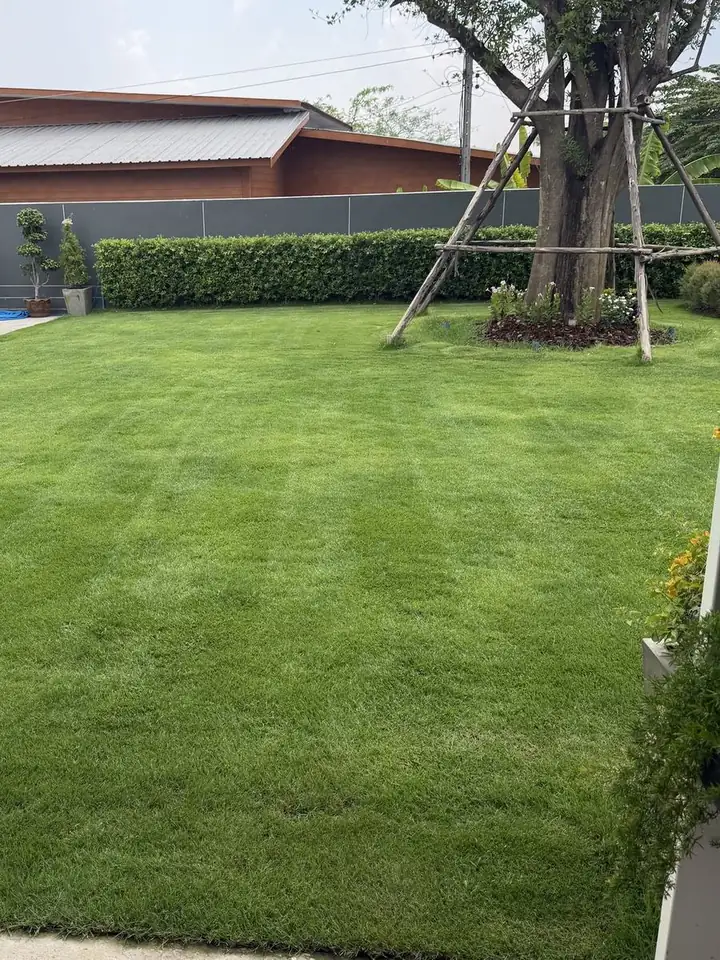
Sun: count the hours.
Zoysia needs at least six to eight hours of sun a day and grows best in full sun. In moderate shade it thins out and competes badly.12 A Thai grower says the same thing in fewer words: it likes strong sun all day.4
Full sun. This is what Japanese Sungrass wants.
The six-to-eight-hour floor is the University of Missouri's.12 The rating for Malaysian grass is a Thai sod farm's.1
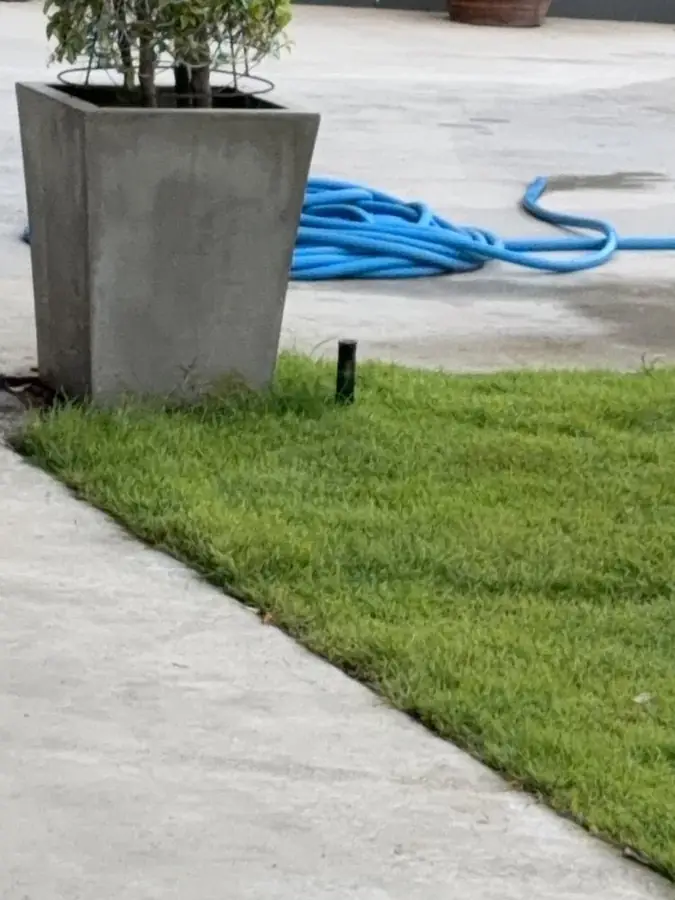
Water: deep, early, and only when it asks.
- Water when the grass shows it is dry. The leaves roll or fold, and patches take on a gray or bluish cast.6 7 Thai growers also read yellowing leaves as thirst.3
- Water early in the morning. Watering in the evening can bring on disease.6
- Water deep and then leave it alone. Wet the soil 10 to 15 centimeters down, or deeper, and do not sprinkle a little every day.12 7
- For an amount to start from: Guam's turf researchers give about 13 millimeters every three or four days,7 and Mississippi's give no more than 25 millimeters a week for a settled lawn.11 Stand an empty can on the grass to see how much your sprinkler puts down.11
- Do not overdo it. Too much water brings disease, weeds and pests of its own.11
Mowing: never more than a third.
Keep the lawn between about 2.5 and 5 centimeters,6 12 and never take off more than a third of the blade in one cut.12 Slide to the height you cut to, and the tool gives the height at which it is time to mow again.
You cut to 3 cm. At 4.5 cm, mowing back down to 3 takes off exactly one third.
Every 7 to 10 days
That is how often one Thai farm says to mow Japanese grass, and it says to keep it short. Left long, the grass grows in clumps and shows yellow when it is finally cut.3
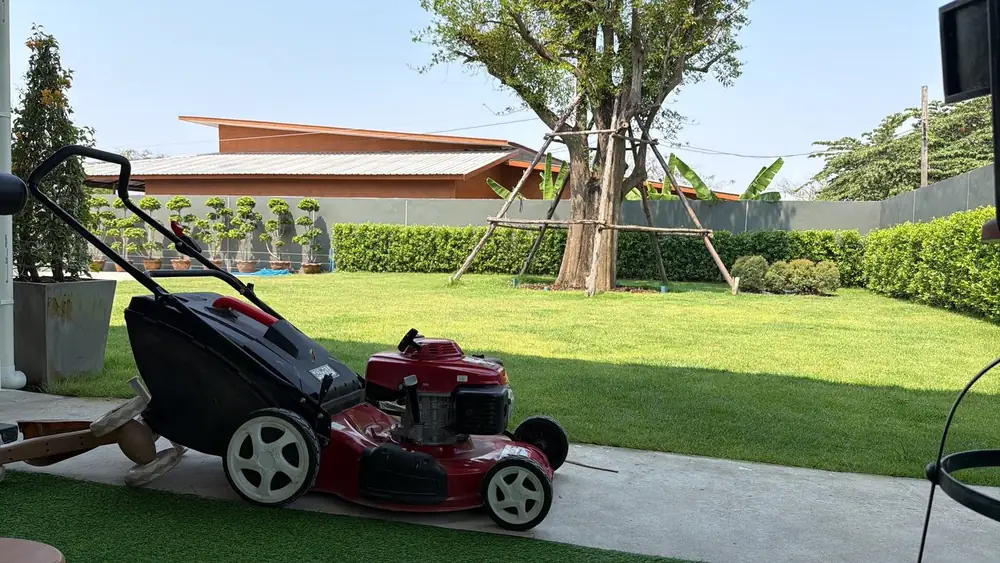
Feeding: twice a year.
New sod should have begun to establish before it gets any fertilizer.1
For an established lawn of common zoysia, the University of Guam's schedule is two feeds a year: about 10 grams of nitrogen for each square meter as the rainy season starts, and about 5 grams near its end.6 Spread it evenly, on dry leaves.6 Go easy. Heavy feeding builds a soft, spongy layer of thatch.6
Guam's figures are 2 pounds and 1 pound of nitrogen per 1,000 square feet. One pound per 1,000 square feet is 4.9 grams per square meter.

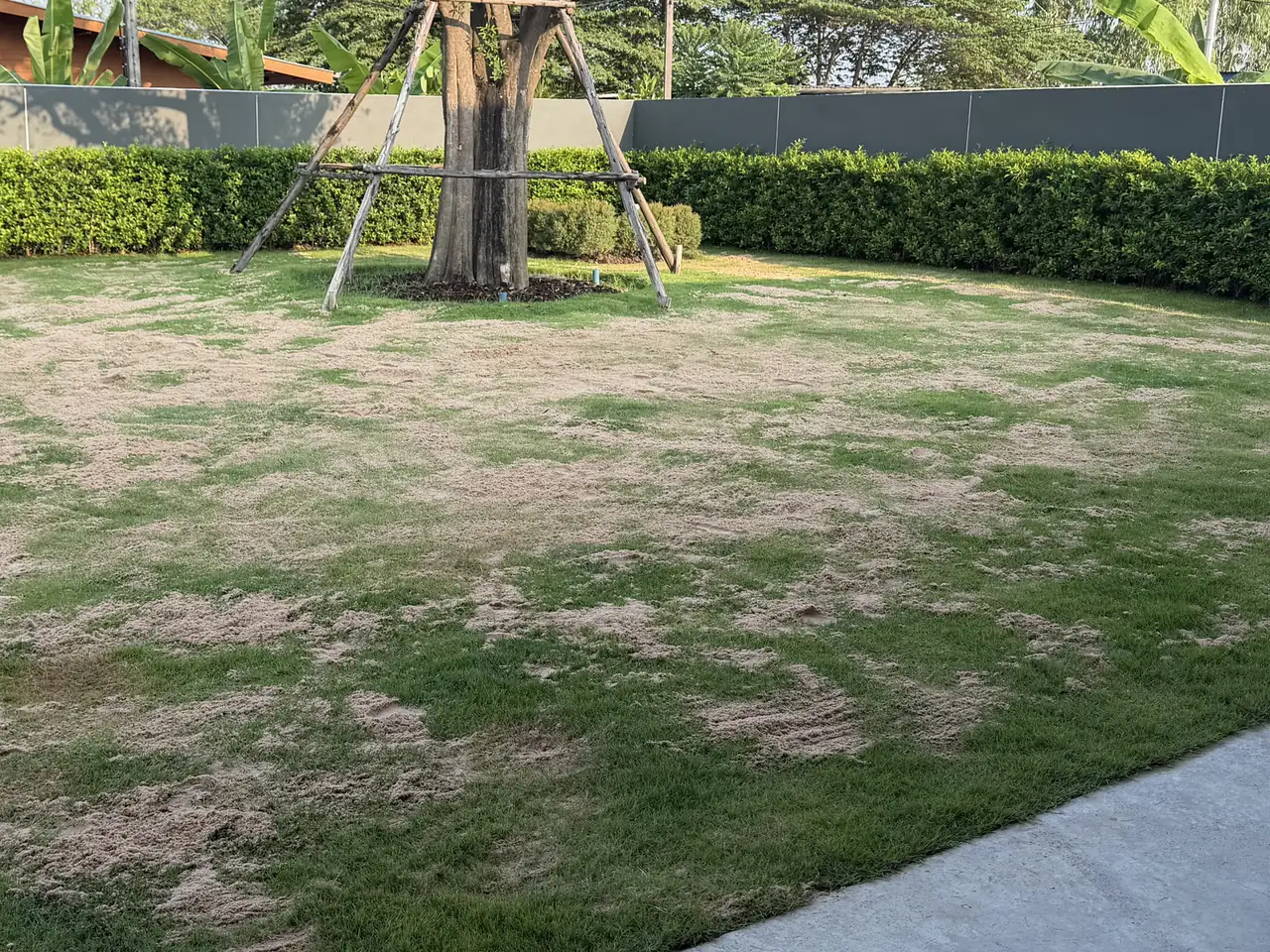
What the sand is for.
Spreading sand or soil over a lawn is called top-dressing. With sand, the purpose is to fill low spots and level the surface. Clemson University's extension service gives the rules.14
- Put down no more than about 1.3 centimeters at a time. A thicker layer shades the grass and stunts it.
- Rake it lightly and evenly, so that it sifts down between the blades.
- Do it while the grass is growing strongly.
- Use sand only where the soil underneath is already sandy. Anywhere else, use topsoil that matches your own, or compost.
Most of the Northeast is a plateau with sandy surface soils,9 so in Isan sand is often the right match. On clay, follow Clemson's rule and use something else.
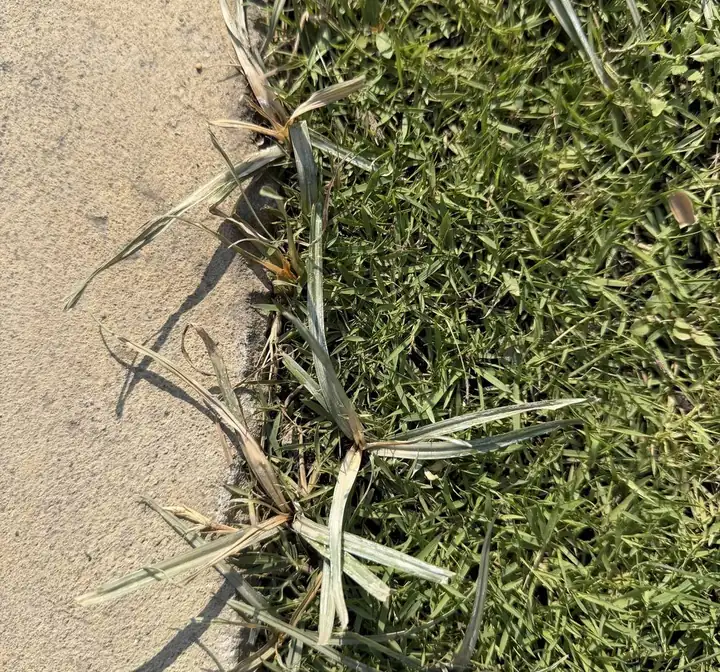
It walks
Zoysia spreads by runners, both along the ground and under it.12 In March 2026 ours set out across the concrete. Trim the edges, or the lawn keeps going.
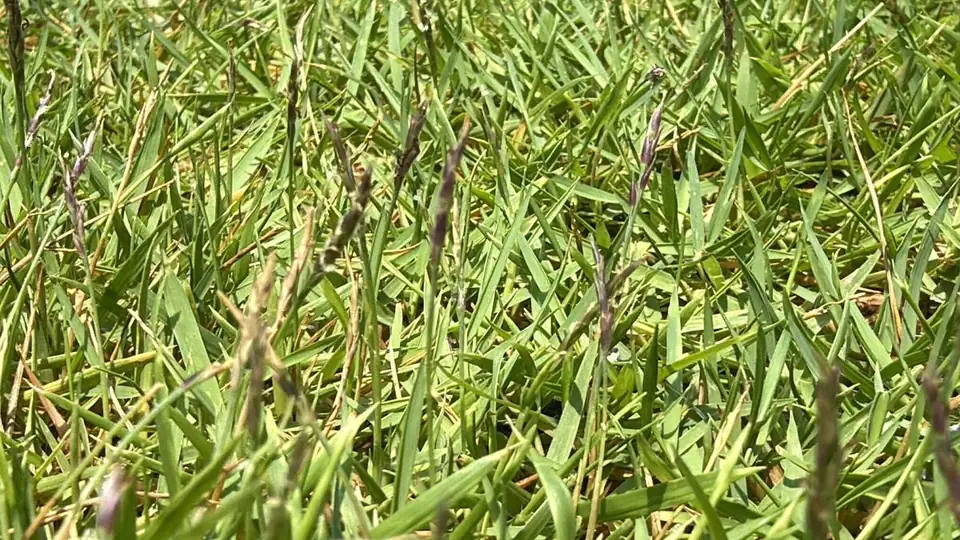
Reading the lawn.
What the grass is telling you, and where each reading comes from.
| What you see | What it usually means | What to do |
|---|---|---|
| Leaves rolled or folded, patches gone gray or bluish | The lawn is dry.6 7 | Water deeply the next morning. |
| Leaves turning yellow | Thai growers read it as too little water.3 | Check the soil with a screwdriver, then water.11 |
| Brown patches that spread in days | Possibly sod webworm, the worst pest of common zoysia.6 | Act early. Left untreated, it can brown a whole lawn within days.6 |
| Thin grass under a tree or beside a wall | Not enough sun.12 | Let in more light, or plant a shade grass there. |
| A springy, spongy surface | Thatch.6 | Rake it out once it is thicker than about 1.3 centimeters.12 |
| Weeds arriving after a dry spell | The lawn has gone without water or mowing.5 | Go back to regular watering and mowing. A dense zoysia lawn keeps weeds out by itself.3 |
Tell us the area and the address.
We come back with the grass and the delivery added up as one total, so you know the whole cost before you say yes.